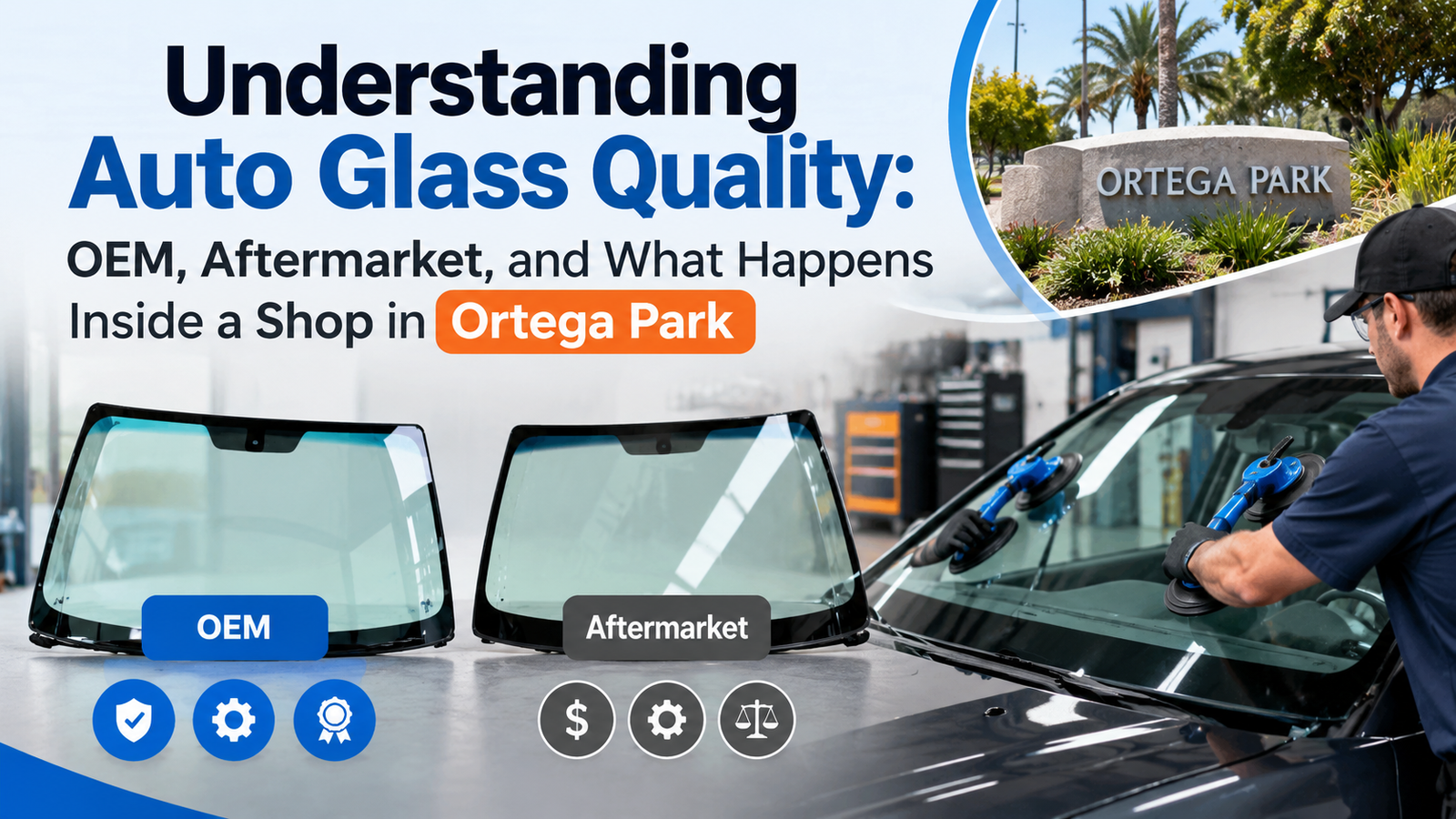
When a windshield is replaced, the driver sees the result but rarely the decisions behind it. Which glass was selected, how it was made, what it is bonded with, whether its markings match its position, and how well it fits the opening are all choices that shape how the glass performs for years. Most of those choices are invisible once the work is complete, and the vocabulary that surrounds them, from OEM to aftermarket to frit to urethane, can make the subject seem more mysterious than it is.
This article explains the dimensions of auto glass shop Ortega Park quality in plain terms. It describes how glass is manufactured, what the common labels mean, how fit and optical clarity are judged, what role adhesives play, and how all of this plays out in a shop. It also considers the setting of Ortega Park, the Sunnyvale neighborhood known for its residential streets, schools, and nearby transport corridors, and the local conditions that influence how vehicle glass lives and ages. The goal is to build understanding, not to promote any brand or provider.
The Neighborhood Context
Ortega Park is a residential neighborhood in Sunnyvale, a city at the heart of Silicon Valley. The area sits close to El Camino Real, Fremont Avenue, Highway 85, and Highway 82, with easy access to Highway 101 and Interstate 280. Many households include commuters who drive daily to technology companies, laboratories, and offices around the South Bay.
That context means a large share of vehicles carry modern technology, including cameras, sensors, and acoustic or heat-reflective glass. It also means that glass wear is shaped by a pattern of mixed local driving and highway commuting, with occasional exposure to construction and debris. In an environment like this, the details of glass quality have real practical consequences.
How Windshield Glass Is Made
Understanding quality starts with understanding manufacture.
A windshield begins as two sheets of float glass. Float glass is produced by pouring molten glass onto a bath of molten tin, where it spreads out and cools into a very flat, uniform sheet. The sheets are cut to shape and the edges are ground.
A ceramic paint called frit is printed around the border of one sheet. This black band, often with a dotted fade pattern, protects the adhesive from sunlight and hides the bond line. Some windshields also have a shaded band across the top.
The two sheets are placed together and heated in a furnace so that they sag into the same curved shape. This process, called bending, must be precise, because the curve of the glass has to match the vehicle’s opening exactly.
A layer of polyvinyl butyral, or PVB, is placed between the sheets. The assembly is heated and pressed under pressure in an autoclave or similar equipment so the plastic bonds to both layers of glass. The result is a single laminated unit that holds together when it breaks.
Additional features are added where needed. These can include acoustic PVB for noise reduction, infrared-reflective coatings for heat, embedded heating wires, brackets for sensors, and display layers.
Variations in how carefully each step is performed show up in the finished product as differences in optical clarity, fit, and durability.
What the Labels Mean
Terminology in the auto glass world can be confusing, and a few terms come up repeatedly.
OEM. Original equipment manufacturer glass is made by or for the vehicle’s maker to the original specifications. It often carries the car brand’s logo. It is the same glass that was installed on the vehicle when it was built.
OEE. Original equipment equivalent glass is made by another manufacturer to the same specifications as the original, but without the car brand’s logo. It is intended to match fit, thickness, and features.
Aftermarket. Glass produced by independent manufacturers to meet federal safety standards. Quality and exact specifications can vary between manufacturers and product lines, and some vehicles have more aftermarket options than others.
Dealer glass. Glass supplied through a vehicle dealer, usually OEM.
Laminated and tempered. The two basic constructions. Windshields are laminated. Side and rear windows are usually tempered, though some vehicles have laminated side glass.
These labels describe where glass comes from and how closely it follows the original design, which is not always the same as how it performs on the road.
Reading the Markings on the Glass
Every piece of automotive glass carries small etched marks, usually in a lower corner. These marks identify the manufacturer, the safety standard the glass meets, and sometimes the date of manufacture.
A typical windshield bears the following information.
- A Department of Transportation code that identifies the manufacturer
- A designation such as AS-1, which indicates laminated glass suitable for windshields
- Safety standard references and sometimes an ECE number for international markets
- The brand or logo of the manufacturer
- A code indicating the month and year of production
For side and rear windows, AS-2 and AS-3 designations may appear. These identify glass allowed in positions other than the windshield and glass with privacy tint, respectively.
These markings are not decoration. They are how the glass identifies itself as legal and appropriate for its position. Glass that does not carry the proper marks should not be installed in a vehicle.
Fit: Why Millimeters Matter
A windshield sits in an opening that was designed with tight tolerances. When the glass is slightly off in shape, curvature, or thickness, several problems can appear.
Gaps and uneven bond lines. If the edge of the glass sits too close to or too far from the body, the adhesive bead may not support the glass evenly.
Wind noise. Even small gaps can generate whistling at highway speeds.
Trim misalignment. Moldings may not sit flush, leaving visible gaps or rattles.
Stress in the glass. A windshield that is forced into an opening it does not match can develop stress cracks over time.
Sensor misalignment. A camera bracket that is slightly off can affect calibration.
Fit is why glass specified for the exact make, model, year, and trim of a vehicle matters. Windshields that look similar can differ in curvature, bracket position, and coatings.
Optical Quality
Optical quality refers to how clearly and accurately the glass transmits light. In a windshield, imperfections can show up as distortion, waviness, or ghost images.
Several factors affect it.
Flatness of the original float glass. Imperfections in the base sheet carry through to the finished product.
Bending accuracy. Poorly controlled bending can create wavy regions, especially near the edges.
Lamination quality. Bubbles, haze, or uneven interlayers can reduce clarity.
Coatings and tint. Solar and infrared coatings need to be uniform to avoid color shifts or uneven appearance.
Camera zones. In vehicles with driver assistance cameras, the area in front of the lens must be especially clear. Distortion here can affect system performance.
A simple way to assess optical quality is to look through the glass at a straight horizontal edge, such as a roofline or a window frame, and notice whether it bends or ripples as the viewing angle changes. Small variations near the edges are normal. Noticeable warping in the main viewing area is not.
The Role of Adhesive
The adhesive is as important as the glass. Auto glass urethane forms a structural bond between the windshield and the vehicle body. It keeps out water, holds the glass in place during a collision, and supports the airbag.
Several properties matter.
Cure type. Most automotive urethanes cure by reacting with moisture in the air. The cure rate depends on temperature and humidity.
Safe drive-away time. The minimum time before the vehicle can be driven. It varies by product and conditions.
Primers. Special primers prepare the glass edge and any bare metal for bonding. Skipping or misapplying primer can compromise the bond.
Bead shape and continuity. The adhesive should form a continuous, correctly shaped bead around the full perimeter, with no gaps.
Conductivity. Some adhesives are formulated for use with antennas or heated glass.
Adhesive technology has advanced significantly, and modern products can reach safe drive-away strength in a short time. Even so, the bond is only as good as the surfaces it adheres to, which is why preparation matters so much.
Inside a Shop: Where Quality Is Built
Quality is not only a property of the glass and adhesive. It is also a property of the process.
Inspection of the old installation. Technicians look at the bond line, the frame, and any rust or damage that might affect the new installation.
Surface preparation. Old adhesive is trimmed to a thin, uniform layer. Rust is treated, and bare metal is primed.
Dry fitting. In some cases the new glass is placed in the opening without adhesive to check alignment and fit.
Controlled adhesive application. A steady, even bead is applied in a continuous line.
Accurate setting. The glass is placed and pressed into position so that the adhesive compresses to the proper thickness.
Cure monitoring. The vehicle is left to cure for the specified time, and conditions such as temperature and humidity are considered.
Calibration and testing. Driver assistance systems are recalibrated and checked, and the vehicle is inspected for leaks and noise.
Cleanup and documentation. Surfaces are cleaned, and records of the work are kept.
A controlled shop makes it easier to carry out these steps consistently, though the skill of the people doing the work remains the most important variable.
Features That Must Match
New glass has to match every feature of the original, and mismatches are a common source of problems.
- Rain sensor and light sensor areas. The glass must have the correct zones for these devices.
- Camera brackets. Bracket position and shape must be correct for calibration.
- Heated elements. Wiper de-icers and heated windshield lines need to match.
- Head-up display layer. The glass must include the correct reflective layer.
- Acoustic layer. Some vehicles use quieter laminates that are thicker.
- Antenna. Some windshields carry radio, GPS, or toll tag connections.
- Tint band and frit pattern. These affect appearance and sun protection.
Because of this complexity, glass is identified by part numbers that reflect the vehicle’s options, and the vehicle identification number is often used to find the correct match.
Environmental Conditions in Ortega Park and Sunnyvale
Local conditions influence the way glass ages.
Warm, dry summers. Sunnyvale experiences long stretches of sunny, warm weather. Heat builds inside parked vehicles, and rapid cooling can stress the glass.
Mild, damp winters. Rain exposes chips to moisture and carries road film that smears under wipers.
Highway commuting. Highway 85, Highway 101, and Interstate 280 are busy, and truck traffic and construction produce road debris.
Tree-lined streets. Sap, pollen, and fallen debris accumulate on parked cars.
Apartment and shopping center parking. Tight parking increases door dings and minor impacts.
Sprinklers and hard water. Mineral deposits from irrigation water can spot glass and, if left in place, etch the surface.
Technology-dense fleet. A high number of vehicles with cameras and sensors means that glass matching and calibration are common.
Common Misunderstandings About Quality
“OEM is always best and aftermarket is always worse.” Quality depends on the specific product and manufacturer, not just the label. Fit, clarity, and compatibility with vehicle features are the real tests.
“If it looks fine, it is fine.” Many quality issues, such as adhesive coverage and bond strength, are invisible from the outside.
“The markings are optional.” They are how the glass shows it meets safety standards for its position.
“Any adhesive will work.” Automotive structural adhesives are engineered for the job, and the wrong product can fail.
“Speed is everything.” Fast installation is useful, but only if every preparation and cure step is respected.
“Calibration is a formality.” It determines whether safety systems read the road correctly.
Questions Worth Understanding
Without turning this into a checklist for any specific decision, it is useful to know the kinds of questions that illuminate quality.
- Is the glass identified by the vehicle’s identification number or equivalent information?
- Does the glass carry the appropriate markings for the position?
- What adhesive and primer are used, and what is the safe drive-away time?
- Is calibration needed, and how is it carried out?
- What aftercare is recommended for the first days?
- How is the old bond and frame inspected for rust?
These questions help reveal how seriously the process is taken.
Frequently Asked Questions
What is the difference between OEM and aftermarket glass?
OEM glass is made to the vehicle manufacturer’s specifications and often carries its logo. Aftermarket glass is produced by independent manufacturers to meet federal standards, and fit and optical details can vary.
What does AS-1 on a windshield mean?
It indicates laminated glass that is suitable for use anywhere in the vehicle, including the windshield, with a high level of light transmission.
What is frit on a windshield?
Frit is the black ceramic paint around the edge of the glass. It protects the adhesive from ultraviolet light and creates a clean visual border.
Why does glass fit matter so much?
The windshield is part of the vehicle’s structure and its curvature must match the opening. Poor fit can cause noise, leaks, stress in the glass, and sensor misalignment.
What is safe drive-away time?
It is the minimum period after installation before the vehicle should be driven, so the adhesive can reach the strength needed to hold the glass in a collision and support the airbag.
Can distortion in a windshield be normal?
Slight variation near the edges can be normal, but noticeable warping in the main viewing area is a sign of poor optical quality.
Does every windshield need calibration afterward?
Only vehicles with cameras or sensors tied to the windshield require it, but that now includes a large share of modern cars.
Does hot weather affect adhesive curing?
Yes. Warmth and humidity speed curing, while cold, dry conditions slow it. Technicians choose products and plan around local conditions.
Final Thoughts
The quality of an auto glass replacement is the sum of many small decisions: how the glass was made, whether it matches the vehicle, how the adhesive was chosen and applied, how carefully the frame was prepared, and whether the systems that depend on the glass were checked. None of these steps is dramatic, but together they determine whether a windshield performs as a silent, structural part of the car or becomes a source of leaks, noise, and distortion.
For anyone learning about an auto glass shop in Ortega Park and the Sunnyvale area, the most useful takeaway is that glass work has a vocabulary and a logic that can be understood. Knowing what the labels mean, how markings work, why fit and adhesive matter, and how local conditions affect glass makes it much easier to follow what is happening, and to appreciate how much careful process sits behind a clear, quiet windshield.